
Agentic AI · Public services & sanitation
Swachh Gaon
Predict tomorrow's waste. Optimize today's routes.
Client under NDA
- Industry
- Public services & sanitation
- Timeline
- 20 weeks
- Platforms
- Web dashboard · Voice agent
- Year
- 2025–2026
Results
What changed, and how we measured it
35%
Reduction in operating costs
Operating cost per collection route, before vs. after forecast-led routing
90%
Waste volume prediction accuracy
Predicted vs. actual daily volume per village, on held-out data
50+
Villages on optimized routes
Villages on forecast-led routes in the live system
$25K
Saved every year
Estimated annual saving from shorter routes and less fuel
The story
Predict tomorrow's waste. Optimize today's routes.
Challenge
- Trucks drove full routes regardless of demand, burning fuel on half-empty stops.
- Overflowing sites were missed because volumes were unpredictable from day to day.
- Drivers had limited connectivity and literacy barriers, so written instructions often failed.
- Managers had no live view of collections, so problems surfaced only after complaints.
What we did
- Audit the data: Collected historical pickup records, village population, seasonality and market days to build a clean training set.
- Forecast volumes: Trained Random Forest models to predict daily waste per village, reaching 90% accuracy.
- Plan the routes: Fed the forecasts into a route optimizer that balances truck capacity, distance and priority stops.
- Close the loop: Added a voice agent for driver briefings and a dashboard for managers to track every route in real time.
Result
- Operating costs down 35% through shorter, demand-based routes.
- 90% accuracy on daily waste volume predictions.
- Routes optimized for 50+ villages, saving around $25K a year.
Product
The system in use
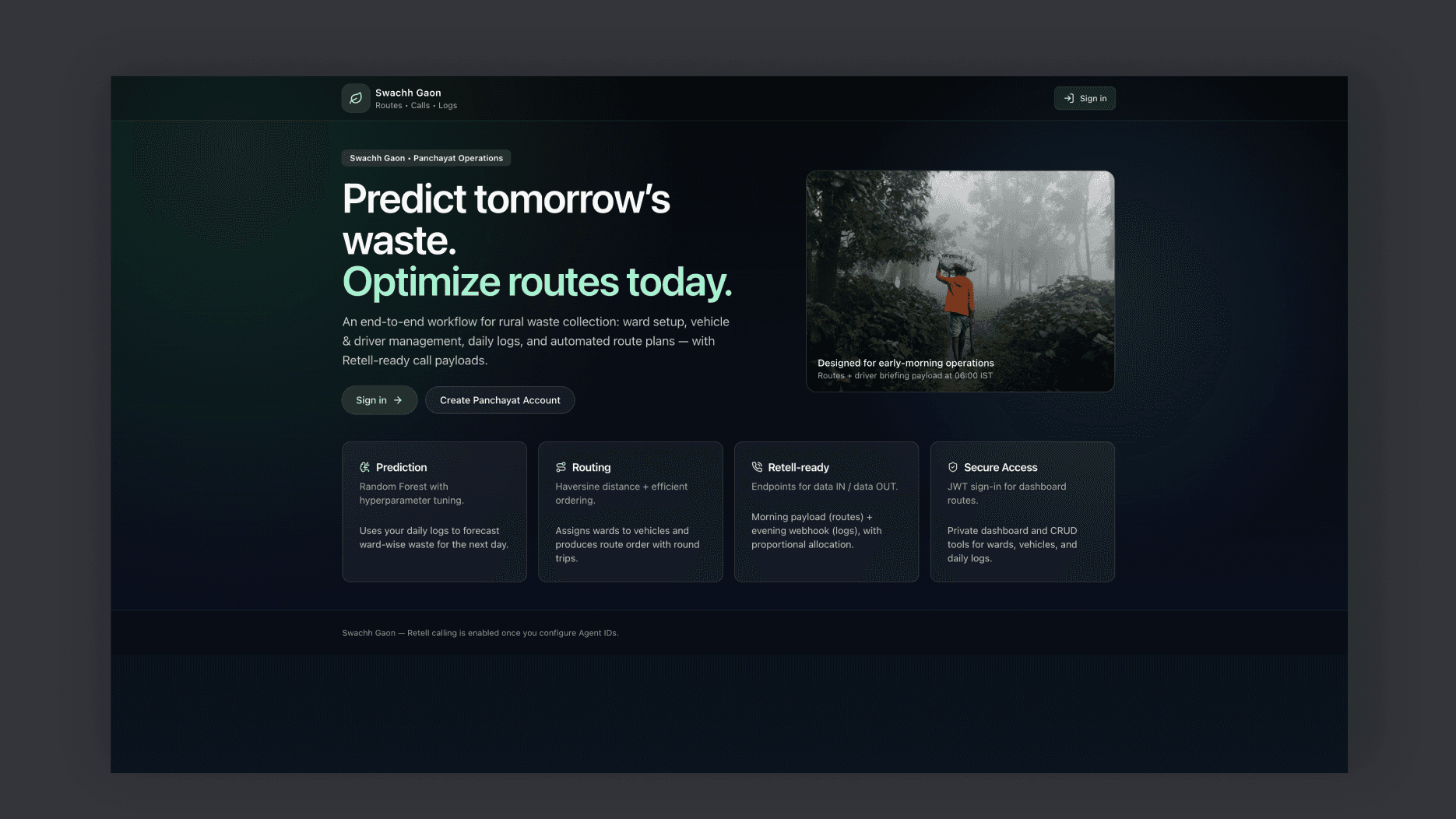
How it works
Five steps, every day
Ingest
Pickup history and village data land in PostgreSQL.
Predict
Scikit-learn models forecast tomorrow's volume per village.
Optimize
The route planner builds truck-by-truck routes from the forecast.
Brief
A Retell AI voice agent walks each driver through their route.
Monitor
FastAPI streams progress to the React dashboard for managers.
Four parts, one system
Waste volume prediction
Random Forest models forecast daily volumes per village from history, seasonality and local events.
Route optimization
Generates daily routes that skip low-volume stops and prioritise sites at risk of overflowing.
Voice agent driver briefings
A Retell AI voice agent calls drivers with their route and priority stops, in plain spoken language.
Real-time monitoring dashboard
Managers see routes, completed pickups and exceptions live, instead of waiting for end-of-day reports.
Built with
- Scikit-learn
- Random Forest
- Retell AI
- Python
- FastAPI
- PostgreSQL
- React
Delivery
Discovery & data audit (weeks 1-3) → Prediction model (weeks 4-8) → Route optimization (weeks 9-13) → Voice agent & dashboard (weeks 14-17) → Pilot & rollout (weeks 18-20). A team of 2–4 engineers.
Related
Related client cases
Free · 30 minutes · No sales deck
Want results like Swachh Gaon?
Talk to a senior engineer, not a salesperson. You'll leave with three concrete next steps — whether or not you work with us.